
Blog
Hemp in Denim: Revisiting a Heritage Fiber

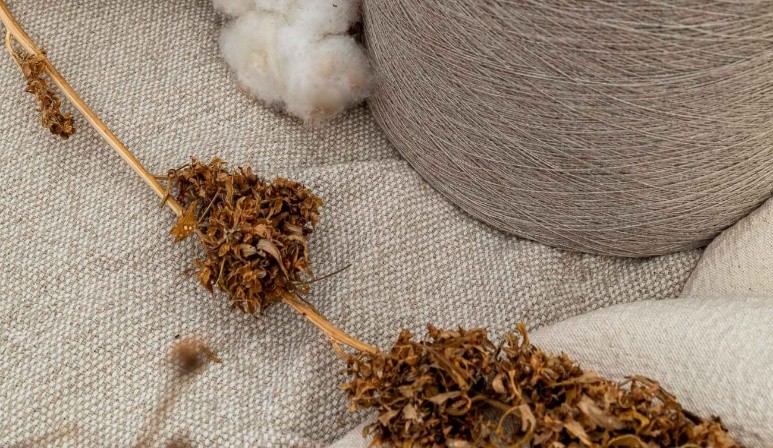
Denim has always been defined by durability and character. Its origins date back to 17th century France, where a sturdy fabric known as serge de Nîmes was manufactured. Over time, was shortened to “denim”. At the same time, a similar blue-dyed fabric was used by fishers in Genoa, Italy. Its French name, bleu de Gênes, is believed to be the origin of the global fashion staple now known as “jeans”.
However, the history of jeans as we know them today is also closely linked to 19th-century workwear. In 1871, tailor Jacob Davis began reinforcing with metal rivets the stress points of the trousers for miners in Nevada (USA). Two years later, together with Levi Strauss, his system was patented, giving rise to a new generation of particularly durable work trousers. Initially also made from duck cloth, a canvas-like fabric, blue denim soon became one of their defining materials.

Despite its long history, denim has always been evolving, reflecting social and cultural changes- from workwear during industrialization to becoming, throughout the 20th century, an everyday garment and an icon of popular culture. In particular, during the 1960s and 1970s, jeans took on an international cultural significance that has endured to this day.
While cotton has traditionally been at its core, the industry is once again looking at alternative fibers that can support both performance and environmental goals.
One of these is hemp—a fiber with a long history in textile production valued for its strength and resistance. Traditionally used in workwear and ropes, hemp is a relevant alternative in denim manufacturing.
From a sustainability perspective, hemp offers clear advantages. It grows quickly, requires no irrigation, and typically needs no pesticides. These characteristics have contributed to renewed interest in hemp within the textile industry.

Intercot combines hemp and cotton for denim applications, bringing together the strengths of both fibers: hemp contributes durability, breathability, and resilience, while cotton maintains softness and processing familiarity. The blend is compatible with existing industrial processes, supporting a gradual integration into current denim production systems rather than requiring significant change.
As the textile industry continues to explore more resource-conscious materials, hemp is gradually re-entering the conversation around the future of denim – not as a replacement for cotton, but as part of its ongoing evolution.
Sources: La Chanvrière (2024). Le Chanvre c’est quoi? www.lachanvriere.com
Levi Strauss & Co. (2012). Happy Birthday, Blue Jeans! www.levistrauss.com
Smithsonian Magazine (2011). The Origin of Blue Jeans www.smithsonianmag.com
The Journey. Jeans: Meaning, Origin & Etymology. www.etymology.life


